
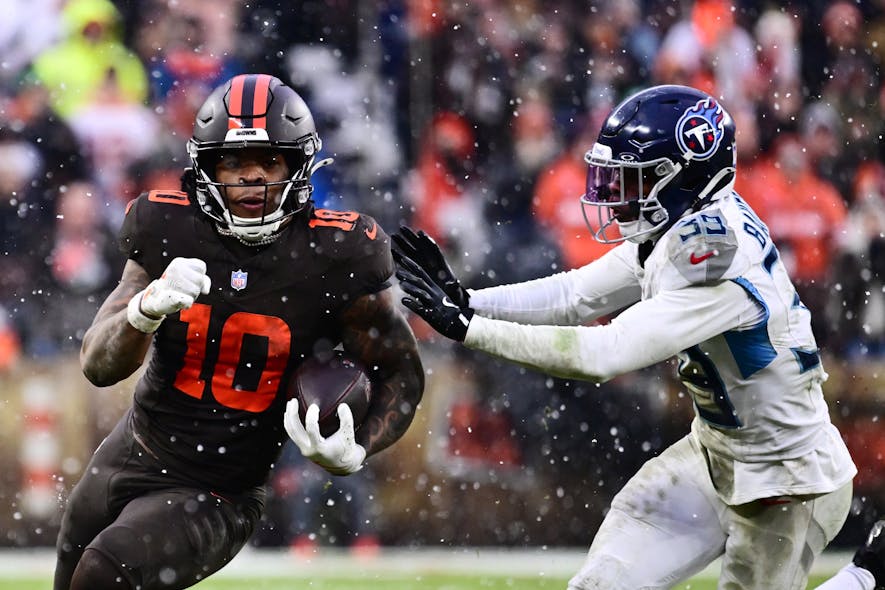
This week, I'm discussing lessons learned from the 2025 season.
STRAIGHT, NO CHASER: 2025's CLIFF'S NOTES
- Why did Quinshon Judkins fail to become a fantasy RB1? Quarterbacking -- something as important as volume, scheme, and individual talent.
- Michael Wilson and Alec Pierce are examples of players who can actually improve after reaching the NFL.
- Rico Dowdle is a lesson in how to demonstrate patience as a fantasy GM without hurting your dynasty squad.
- Harold Fannin Jr. is a lesson in how to analyze athletic metrics.
- Davante Adams and Puka Nacua provide us a lesson on how two wide receivers on opposite ranges of the position's spectrum can deliver top-tier fantasy value.
- Omarion Hampton was a misadventure in wish-casting.
- Bhayshul Tuten was the less successful wish-casting sequel.
- I missed on Brian Thomas Jr., because I glossed over who was fueling Thomas' rookie production.
- Kyler Murray is Exhibit A that a player can be a good fantasy quarterback, but limit his surrounding talent.
- Tetairoa McMillan is fool's gold as a primary wide receiver -- at least for now.
1. Quinshon Judkins: When Volume Doesn't Dictate An RB1 Future
When Quinshon Judkins delivered 95 yards and a score on 19 touches against the Packers' defense in Week 3, the fantasy community proclaimed Judkins an RB1 based on volume, scheme, and individual talent.
Despite buying Judkins as an RB1 talent, pre-draft, the Gut Check feature I did on Judkins arrived at different conclusions:
Conclusions From the Quinshon Judkins Data
- Judkins is an efficient volume runner, based on his offense.
- Judkins can move the chains effectively between the tackles.
- Cleveland's offense wins with long drives and occasional big-play shots.
- Cleveland's offense complements an attacking defense that's among the best in football.
- Judkins' receiving game may increase slightly, but not enough to make him a top-12 fantasy RB in this era.
- The best shot for Judkins to become a top-12 fantasy RB is a high volume of rushing TDs.
- The Cleveland offense lacks a true primary receiver to deliver the firepower for Judkins to earn top-tier TD volume.
Quinshon Judkins is a fantasy RB2 this year as long as the offense and defensive lines in Cleveland remain healthy and Joe Flacco is under center. Judkins' volatility increases significantly if any of these factors change.
By trading Flacco, Cleveland traded away the only quarterback with the experience and knowledge of the offense to get the running game out of bad calls and into good ones. Relative to Dillon Gabriel and Shedeur Sanders, Flacco was more adept at changing alignments, the direction of the play, getting out of a run, calling a different run, or going from a passing play to a running play.
Having a veteran quarterback with the knowledge and experience to adjust to what they see at the line of scrimmage increases a running back's likelihood of breaking big-play runs. It's not just about the running back's individual talent or how well the lineman graded out at PFF.
Once Flacco left for Cincinnati, Judkins hasn't had another 100-yard game. He's had six weeks under 60 yards rushing -- four of them under 40!
Judkins earned 9 catches during his first four games with Flacco at quarterback. Since then? 12 catches in nine games -- including four games without a catch.
Football is not as simple of a template as the data points lead you to believe.
Cleveland's heavy offensive fronts may encourage heavy defensive fronts and a lot of volume, but without a quarterback who could either A) offer big-play value with their legs to distract opponents from the running back or B) change plays at the line of scrimmage to the benefit of the ground game, the running game has limited upside.
While a rookie quarterback with a summer spent earning first-team reps could change plays to benefit the ground game, a QB without those reps is unlikely to have the knowledge, experience, or even the permission to alter play calls.
It made Quinshon Judkins an RB1 talent with a low-end RB2 system. Volume only matters if the infrastructure of the offense is there to support quality volume.
2. Michael Wilson and Alec Pierce: NFL Players Can Improve
Most people don't evaluate NFL players when they were in college. Their baseline for improvement is the player's first two years in the league.
This often leads to misinformed perceptions of players.
When people see rookie mistakes, they don't realize that many of these mistakes aren't errors the player made in college. A new system and better competition can lead to errors that a player hasn't made since he was in high school.
These players are trying to integrate advanced things into their games at a breakneck pace, and it can lead to their overall games breaking down in ways that they didn't anticipate -- careless conceptual errors, sloppy technique, and even errors with physical coordination.
Once the player gains comfort with the scheme and speed of the game, these breakdowns diminish, and he begins to resemble the player he was in college. For most of the public, this appears to be the player has improved when he's simply more comfortable with the scheme.
We're seeing fewer egregious errors, and it looks like improvement, but these "errors" often aren't the actual flaws of the player's game. This is why I've heard from many film watchers and coaches at various levels who believe players rarely get better -- they just get more comfortable with the scheme that will mask a lot of their flaws.
This is true. It's also true that some players improve.
Michael Wilson was an excellent route runner at Stanford. That part of his game translated well to the league even though Arizona had a starting quarterback in Kyler Murray who wouldn't climb a pocket and keep timing routes alive. Murray's style of play limits the talents of players like Wilson.
Wilson's hands were a different story. Wilson had egregious drops at Stanford, but there was evidence that his technique could improve.
Wilson had enough reps on film to showcase what he could become as a pass-catcher. He could make difficult adjustments high, low, wide of target, in tight coverage, and after contact. However, he didn't make enough to project starter-caliber hands.
The details Wilson needed to address were centered around technique and timing. Pre-draft, Wilson displayed that he was an organized learner, and he was aware of his issues. Many prospects don't show this awareness or have a plan to address them.
It's why Wilson made that leap. We'll see if the Cardinals can do more in 2026 to leverage his talents.
Alec Pierce reminded me of a Justin Jefferson Starter Kit with better size and short-area explosion, but lacking Jefferson's route-running prowess. The keys for Pierce were to become more than a big-play contested catch threat at the boundary and develop his route skills against man-to-man.
Pierce has made that leap this year. According to Bob Harris, beat reporters covering the Colts see Pierce as the best receiver on the team. Until Daniel Jones got hurt, Pierce was also making that move statistically and with his route and target selection.
The stats will often give you context on whether a player has or hasn't reached his potential. The problem is that the public and analyst community look at the stats and write off the player when they have zero knowledge of that player's skills and how those skills are evolving.
The film gives you context. If the film shows an improving player, but the system or surrounding talent is an obstacle, patience can prevail. It doesn't mean clogging your roster with an unleverage talent, but it doesn't mean writing off the player with a value judgment.
When you do that, you unintentionally close your mind to the moment where that player becomes exploitable.
Speaking of which...
3. Rico Dowdle: How to Approach Patience Plays
Dowdle was another RSP favorite when he arrived in Dallas in 2020. After delivering 384 yards and 2 scores in his first 4 seasons, Dowdle has 2,057 yards and 8 touchdowns in the last 30 games.
The lesson with Dowdle is how to display patience as a fantasy GM and not hurt your dynasty team. You weren't going to clog your dynasty rosters with Dowdle in Dallas for his first three seasons because he was either on IR or the practice squad.
You were going to add Dowdle to your expanded offseason rosters every summer until roster cut-downs. When Dowdle earned the start in Dallas, you were going to factor that he earned a "hard" 1,000 yards behind a bad offensive line and without their starting quarterback for half of the season.
When Dowdle earned the No. 2 role in Carolina, you were going to stash him whenever you had room for a starting-caliber RB to sit on your bench until something better came along.
Too many people write off talents like Dowdle because they approach every process with a formula or a model that doesn't provide any contextual value for talent.
Dismiss a player without understanding his game on the field, and you're less likely to leverage the opportunities to add him when they are meaningful.
This probably happened with Blake Corum at the end of last year. It will likely happen with Sean Tucker in 2026.
4. Harold Fannin Jr.: Analyzing Athletic Metrics
Draft season can be a roller coaster. Harold Fannin Jr.'s draft season was a perfect illustration.
Fannin's draft stock climbed up a big hill around this time last year as a small-school prospect earning big-time attention thanks to his highlights, box scores, and performances against bigger schools. The top of that hill for Fannin was the NFL Combine.
When the festivities in Indianapolis ended, Fannin went from a public favorite to a pariah -- and for all the wrong reasons. People don't understand how to analyze the data.
They don't know how to value Relative Athletic Score (RAS). A fun and informative metric, RAS gives you how a player's metrics fit along the continuum of combine participants. RAS doesn't tell you what the acceptable baselines are for each metric based on the position, much less the role that position may play in an offense.
Fannin's career max speed at Bowling Green was 20.3 MPH, and his average top speed for his fastest moments was between 19-19.5 MPH. Sam LaPorta's career max speed at Iowa was 21.1 MPH, and his average top speed for his fastest moments was 19.6-20 mph.
It was a mistake to look at Fannin's speed numbers and say they are bad because they don't match up exactly with LaPorta's. It's correct to look at Fannin's data and know that his on-field measured speed meets the standard for NFL starters at the position, and his initial acceleration and change of direction exceed it.
Although LaPorta's vertical routes leading to huge games as a rookie will remain emblazoned in the minds of fantasy GMs for years, the success of LaPorta's game doesn't hinge on speed. Most of these vertical wins came on long-developing play-action routes against zone anyhow. Routes Fannin could have won in the same situation.
The success of LaPorta – and Fannin's – game hinges on short-area acceleration, change-of-direction-quickness, and precision. In this respect. Fannin's physical resources off more than enough for him to succeed in the same respects as LaPorta.
Fannin and LaPorta are both former wide receivers who transitioned to tight end.
Pre-draft, they were essentially the same height and weight. Fannin delivered a 4.39-second, 20-Yard Shuttle and 6.97-second, 3-Cone Drill.
LaPorta delivered a 4.25-second 20-Yard Shuttle and a 6.91-second, 3-Cone Drill. His vertical leap was 35 inches – one more than Fannin.
Based on my grouping of the workout data, LaPorta and Fannin are in the same performance tiers for each drill listed above. The greatest difference is in the 40-yard dash.
LaPorta's 4.59-second performance is 0.01 seconds inside the Elite Tier in the Rookie Scouting Portfolio. Fannin's 4.71-second performance is 0.01 seconds outside the Starter Tier.
Fans simply looked at the number, maybe the percentile score relative to all Combine participants, and judged pass/fail.
The 40-Yard Dash performance shut down a lot of the pre-draft love for Fannin among the public. Should it have? When reviewing the routes Fannin ran at Bowling Green versus the routes LaPorta ran as a rookie in Detroit, the 40-Yard Dash results wouldn't have mattered much, if at all.
You compare a player's data with baseline standards and assess whether it aligns with his style of play and the demands that will be placed on him. Dalvin Cook's metrics fell below baseline standards in certain areas, but Cooks' curvilinear style of movement didn't match the drills that measure how fast a player cuts.
At the point you throw out that part of the evaluation, not the player. Do you grade a pastry chef on how well he cooks a steak just because both chefs work in a kitchen with many of the same tools?
Not if you have a clue about procuring talent for a restaurant.